My Files
Designing a brand new product for the Eikon platform: the first centralised place for hundreds of thousands of financial professionals to organise their work.
Eikon had dozens of applications that let people save states and views, and nowhere to bring any of it together, so users had turned the favourites feature into a makeshift filing system. There was no predecessor to learn from, which made research the foundation: insight from the customer specialists team and interviews run with the research team produced four personas that kept the scope steady. The most useful decision came from platform data, which showed only a tiny fraction of users nesting folders beyond two levels, so I recommended a two-level limit with an automatic migration that flattened deeper structures with meaningful names rather than building complexity for an edge case.
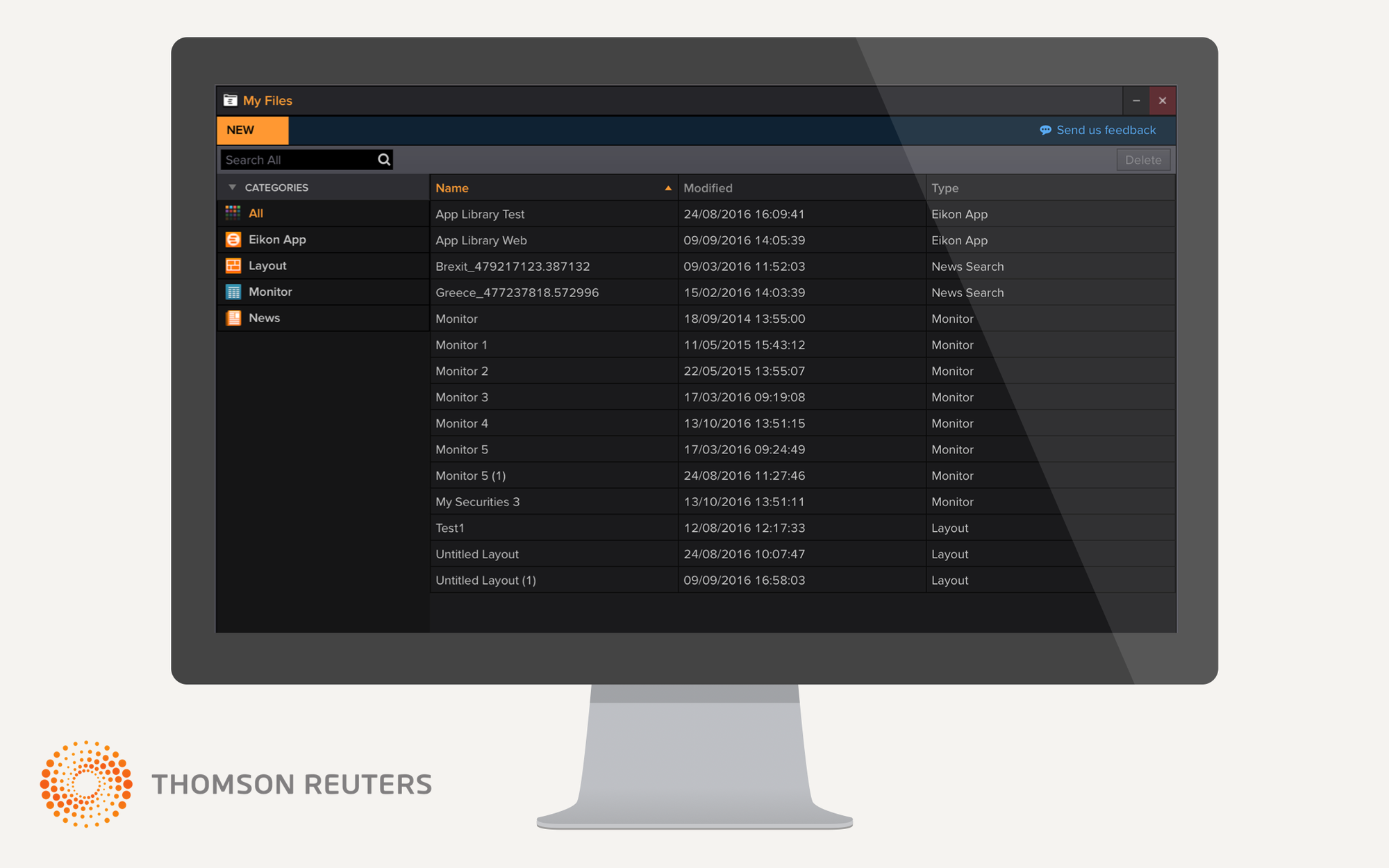
Thousands of saved items, no product to manage them.
The Eikon platform offered dozens of applications that financial professionals used daily. Each allowed users to save custom states, configurations, and views. But there was no centralised place to organise, retrieve, or share any of it. Saved items were scattered across individual applications, and many users had resorted to using the favourites feature as a makeshift filing system.
Unlike the Top News redesign, which improved an existing product, this was a blank canvas. There was no predecessor to learn from, no existing user behaviour to observe within the product, and no established patterns for file management on the Eikon platform. Everything had to be researched, designed, and validated from scratch.
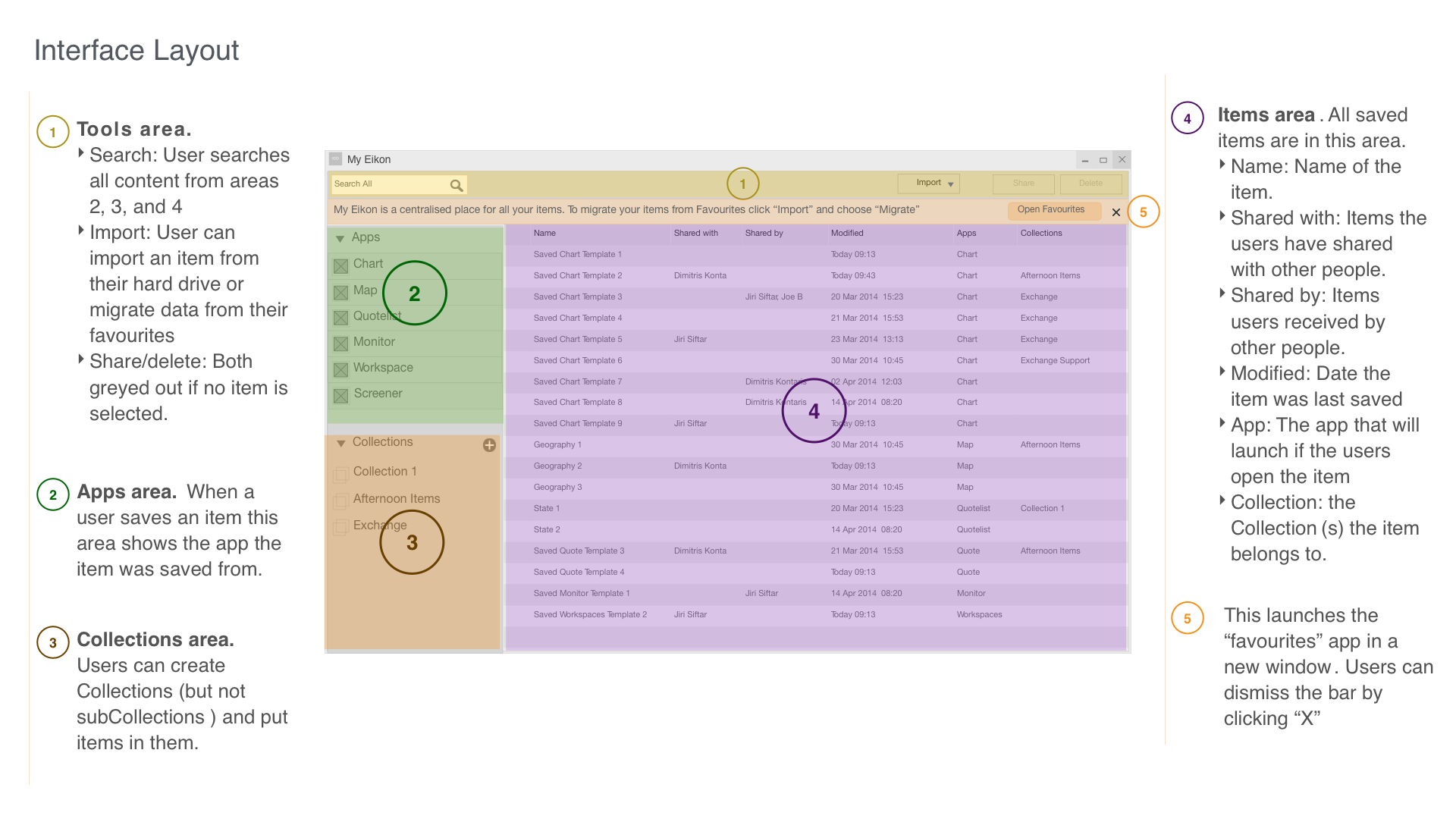
Wireframes broken down by functional area, each analysed to component-level interactions.
No existing product to reference at the time, so discovery and research were key from the start.
I was the sole UX designer, owning the entire process from research through to delivery. With no existing product to benchmark against, the research phase was critical. I worked with the customer specialists team to gather insight from their direct contact with end users, then planned and conducted user interviews with the research team to understand saving, retrieving, and organising behaviours in depth.
Four distinct personas emerged: traders sharing configurations with colleagues, managers setting up apps for new hires, active traders maintaining multiple saved states for different market conditions, and users who confused templates with saved states entirely. These personas shaped every design decision and kept the team grounded when the scope could easily have expanded in every direction.
I broke the interface into functional areas that could be developed and validated independently, and built interactive prototypes in Axure to test behaviours that static wireframes couldn't communicate, like drag-to-group and multi-select.
The most impactful decision came from analytics. Research showed that a small number of users had created deeply nested folder structures, some going many levels deep. Platform data confirmed that only a tiny fraction nested beyond two levels. Rather than building complexity for an edge case, I recommended a two-level folder limit with an automatic migration that flattened deeper structures using meaningful naming conventions. Early testing confirmed this worked for the affected users without adding unnecessary complexity for everyone else.
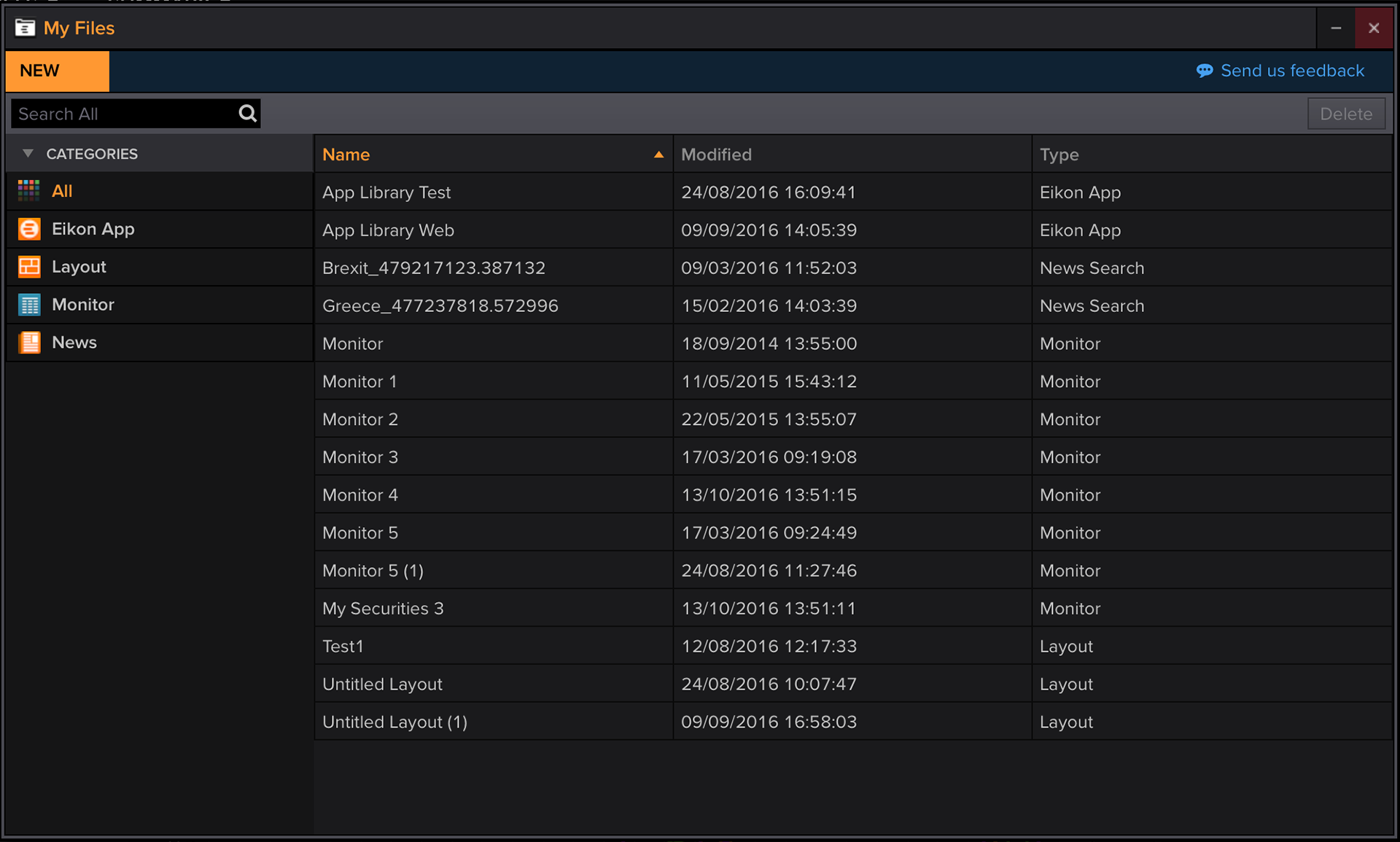
Data-informed decision: two-level folder limit with automatic migration for deeper structures.
A new product that gave the platform something it had never had.
My Files shipped as a brand new application on the Eikon platform, giving users their first dedicated space to organise, group, filter, and share saved items across every Eikon app. The research-first approach meant the team avoided costly rework that would have come from building on assumptions, and the product was validated with users before it launched.
The folder nesting decision is the one I would point to: evidence used to simplify scope, with the deeper structures migrated rather than dropped.
Designed from scratch, no predecessor to build on
Research-driven design serving distinct user needs and workflows
Analytics used to simplify architecture without losing edge cases
Multiple rounds of usability testing before development began